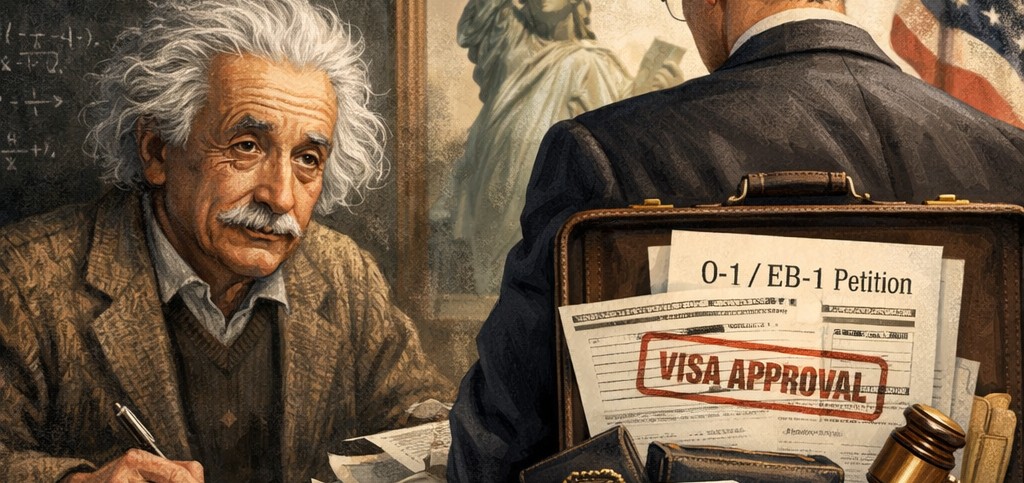
There is a visa category in the United States called the EB-1A. Its nickname, and we promise we are not making this up, is the Einstein Visa.
It exists for people of "extraordinary ability." The best in their fields. Researchers. Scientists. Engineers. Professors. The kind of people who have spent their entire careers doing work that actually moves the world forward.
Here is the thing about the Einstein Visa. In 2024, nearly one in four of those extraordinary people were denied.
And in 2025? Between 40 and 50 percent received something called an RFE, a Request for Evidence, which is essentially the government's way of saying: we've looked at your life's work and we're going to need you to try that again, but harder.
Someone on Reddit described getting an RFE as "the EB-1A version of a jump scare."
They are not wrong.
Now. You might be wondering, what does it actually take to qualify for this thing?
Good question. You need to prove extraordinary ability. Through evidence. Specifically, evidence that other people, credible, independent, important people, have recognised your work as extraordinary. Which sounds reasonable until you realise what this looks like in practice.
It looks like this:
"EB-1A: Where you are an expert, but you also need a lawyer to convince a government agent that you are an expert, based on a letter written by another expert who you only met once at a conference."
That is a real quote from someone who went through this process. And it may be the most accurate summary of it we have ever read.
The bar is high. The criteria are specific. And the process of demonstrating that you meet them is, put kindly, a full-time job on top of the full-time career that made you qualified in the first place.
Let us tell you about someone our team worked with just recently.
A brilliant man. Decades of real, substantive experience. The kind of CV that makes other professionals feel quietly inadequate at dinner parties. He had spent six to eight months reaching out to journalists and publications before we met. Trying to get media coverage. Trying to build the visibility the process demands.
He wrote to forty of them. Forty. International outlets. Trade publications. Industry blogs.
And then, in what we can only describe as a beautiful, desperate act of optimism, publications back home in his home country.
Surely, he thought, someone back home will cover me.
Silence. Forty times over.
He had also spent thousands on lawyer fees. The legal framework was immaculate. The paperwork was a work of art. Nobody had told him that the evidence, the media, the recognition, the visibility, was supposed to be the foundation. Not the finishing touch.
He had built a beautiful house. With no walls. This is the part nobody talks about. The people navigating this process are not ordinary. They never were.
They are the researcher with 3,000 citations who gets told they have a "moderate" chance of approval, while someone else breezes through with a "Global Recognition Award" from a hackathon they paid to judge. They are the scientist who has presented at international conferences, now nervously checking whether their LinkedIn profile has enough engagement to impress a government adjudicator.
They are the engineer who has built systems that millions rely on, now staying up past midnight writing to a journalist who covers their entire industry from a very generalist perspective, and hearing nothing back. From the outside, this looks like strategy.
From the inside, it feels like standing in a room, shouting your credentials, while someone in the corner takes notes on whether enough other people in the room are also writing them down.
Many of these people are also doing this while in between roles. On temporary contracts. Under real financial pressure. Still they keep going. Still publishing. Still applying. Still spending money they cannot easily justify, because the process demands proof of recognition, and recognition, it turns out, does not automatically appear just because you have earned it.
One person put it perfectly:
"My friend just got approved after two years. They didn't win a Nobel Prize in that time. They just finally got an officer who was having a good day."
Dark. Funny. And for the people living it, painfully, recognisably true. Here is what we have come to understand after working with profiles like these. The work is almost always there.
The expertise is real. The contribution is genuine. The career is exactly what it needs to be.
So What's Missing?
What is often missing is the story. Not because there isn't one. But because nobody taught these people that the story needed to be told in a very specific way, consistently, over time, through channels that a process like this recognises as credible.
The pieces exist. They just don't always connect.
Recognition looks concentrated when it should look consistent. Visibility feels recent when the career is long. The narrative is there but it isn't clear yet. And when that happens, even extraordinary people can look uncertain on paper. Not because they aren't qualified.
But because this process doesn't just ask what you've done. It asks how independently, how consistently, and how clearly that work has been seen and validated by others.
That is not something most people are ever taught to think about. Until they are in the middle of it, wondering why forty publications haven't written back.
If you are somewhere in this process right now, whether you know exactly what an EB-1A is or you are simply a brilliant person trying to make your work more visible to the right people, this is for you.
You are not alone.
It is not a reflection of your capability. It is a reflection of how genuinely complex, and occasionally, magnificently absurd, the gap between being extraordinary and being seen as extraordinary really is.
We are always open to a conversation if this is something you are navigating. And if you have already emailed your hometown newspaper in a moment of hopeful desperation, we will not judge you. We have seen it before.
You are in good company. 😄
Somewhere in the middle of this process?
If forty publications haven't written back, or you're not sure how to structure what you already have, we're glad to talk it through.
Start a conversation